GEO: how to get into ChatGPT, Gemini and Google answers
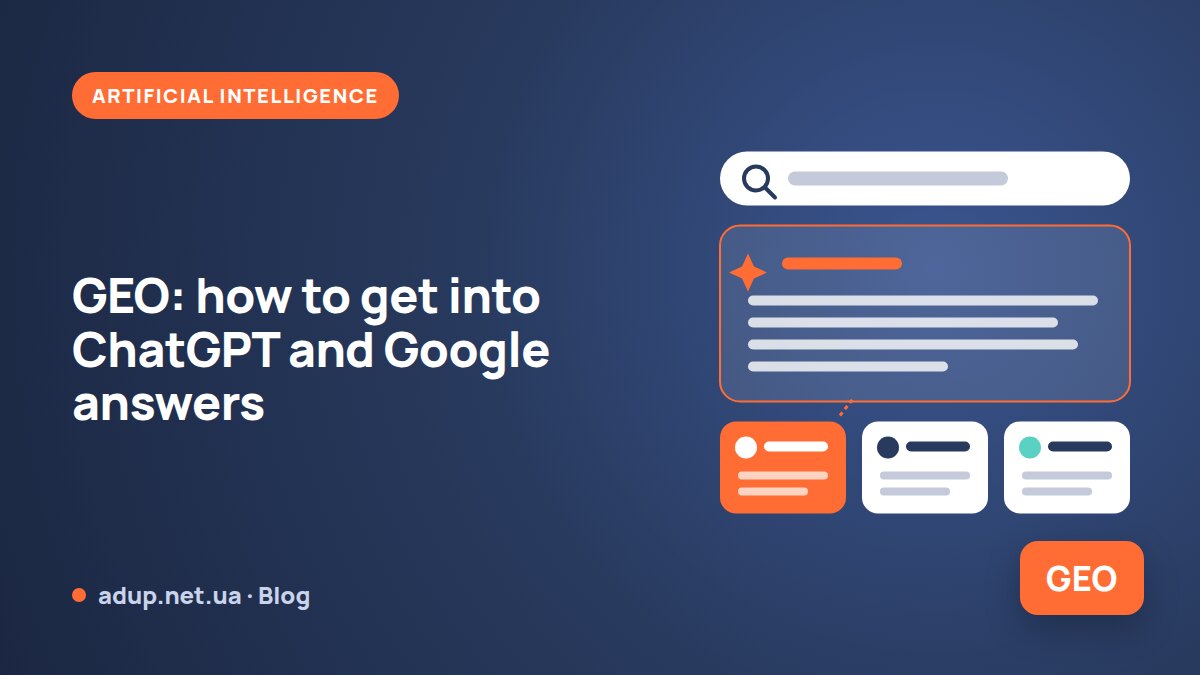
More and more people ask AI models their questions instead of typing into a search bar. ChatGPT, Gemini, Perplexity and Google's AI answers gather information from websites and often link to their sources. Here's how to prepare your site to be one of them.
What GEO is
GEO (Generative Engine Optimization) is optimization for generative search. The goal is the same as with SEO: for customers to find you. The difference is that an AI model doesn't show ten blue links; it composes one answer from several sources. Getting into those few sources is the task.
Step 1. Check that the doors aren't closed
Many sites block AI bots in robots.txt or Cloudflare settings without even knowing it. Check whether these bots are allowed:
- OAI-SearchBot — OpenAI's crawler that finds pages for ChatGPT search;
- GPTBot — OpenAI's crawler that collects data for model training (you can block it separately if you don't want your content used for training);
- Googlebot — both regular Google Search and its AI answers depend on it;
- PerplexityBot — Perplexity's crawler.
Google-Extended only controls the use of your content for Gemini models. It doesn't affect whether your site appears in Google Search, so blocking it "to be safe for search" makes no sense.Step 2. Put the answer first
AI models readily pick up short, self-contained passages. If on a "How much does a website cost" page the answer is buried in the sixth paragraph after the company history, it won't be noticed.
Direct answer
2–3 sentences right below the heading.
Details
Question subheadings, lists, tables.
Evidence
Figures with sources, examples, photos.
FAQ
Short answers to related questions.
Step 3. Tell them who you are
AI is far more willing to cite sources when it's clear who stands behind them. What your site should have:
- an About page with your real story, team and experience;
- the same name, address and phone number on the site, in Google Business Profile and in directories;
- Schema.org markup: Organization, LocalBusiness, FAQPage, Product, depending on the type of site;
- the author of articles and their expertise.
Step 4. Be where people talk about you
AI models rely not only on your site but also on mentions of you elsewhere: reviews, industry directories, media articles, discussions. A company nobody writes about barely exists for AI.
- AI bots aren't blocked in robots.txt or Cloudflare
- The answer to the main question is in the first 2–3 sentences
- Subheadings are phrased as customer questions
- Figures have a source and a date
- There's an FAQ block with FAQPage markup
- It's clear who the author is and which company is behind the site
- Contacts match on the site and in directories
Want ChatGPT and Gemini to recommend your business? We'll do it for you: see our service GEO optimization.
Need help with your website or ads?
Tell us about your task and we'll suggest where to start and propose a solution for your budget.