AI-written content on your website: what Google actually says
"Google bans sites for ChatGPT content" is one of the most common myths in marketing. In reality, Google's rules are about the quality and purpose of content, not the tool. Here's what Google officially says and how to use AI without risk.
Google's position: the result matters, not the tool
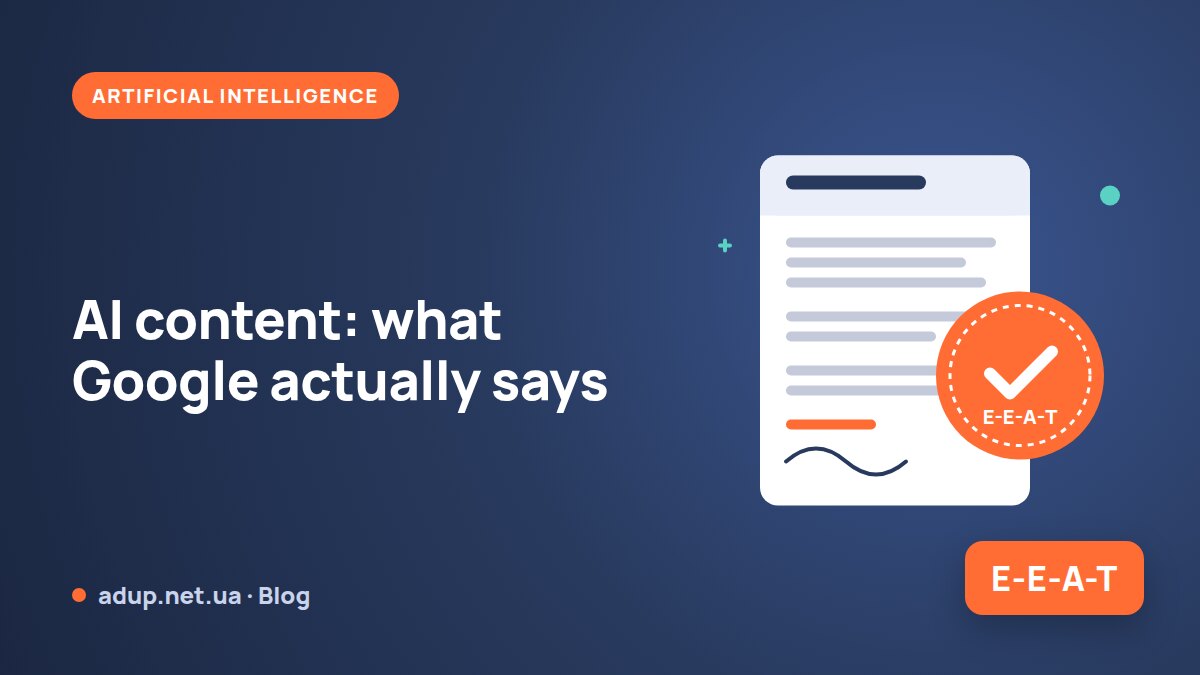
In February 2023 Google published an explanation on its developer blog: ranking systems reward original, high-quality content that demonstrates experience, expertise, authoritativeness and trustworthiness (E-E-A-T), regardless of how it was produced.
At the same time, using automation, including AI, with the primary purpose of manipulating search rankings violates the spam policies. So the problem isn't AI but mass-producing pages "for the robot".
Safe
- AI helps with a draft, an expert adds to it and checks it
- the content answers a real customer question
- it includes your own data, photos, examples
- it's clear who the author is
Risky
- hundreds of near-identical keyword pages with no value
- rewritten articles by others with nothing new
- made-up facts and statistics
- content nobody read before publishing
What changed in 2024
In March 2024 Google updated its spam policies and added a separate item: scaled content abuse (scaled content abuse). It covers generating large numbers of pages that don't help users, whether they are written by people, AI or a combination of both.
The takeaway is simple: ten strong articles that answer your customers' questions beat two hundred auto-generated ones.
Google's three questions for any content
Google advises authors to assess their content through three questions: who created it, how it was created and why.
Author
The reader knows who wrote the content and why they should trust it.
Process
If automation was used, it's appropriate for the reader rather than hidden.
Goal
The content was created to help people, not just to attract traffic.
How we work with AI-written content
Brief
Customer questions, keywords, what competitors already have.
Draft
AI provides the structure and a first version.
Expert
Adds experience and examples, cuts the fluff.
Fact check
Every figure comes with a primary source.
Publishing
Meta tags, markup, internal links.
Need help with your website or ads?
Tell us about your task and we'll suggest where to start and propose a solution for your budget.